
Photography as Medium

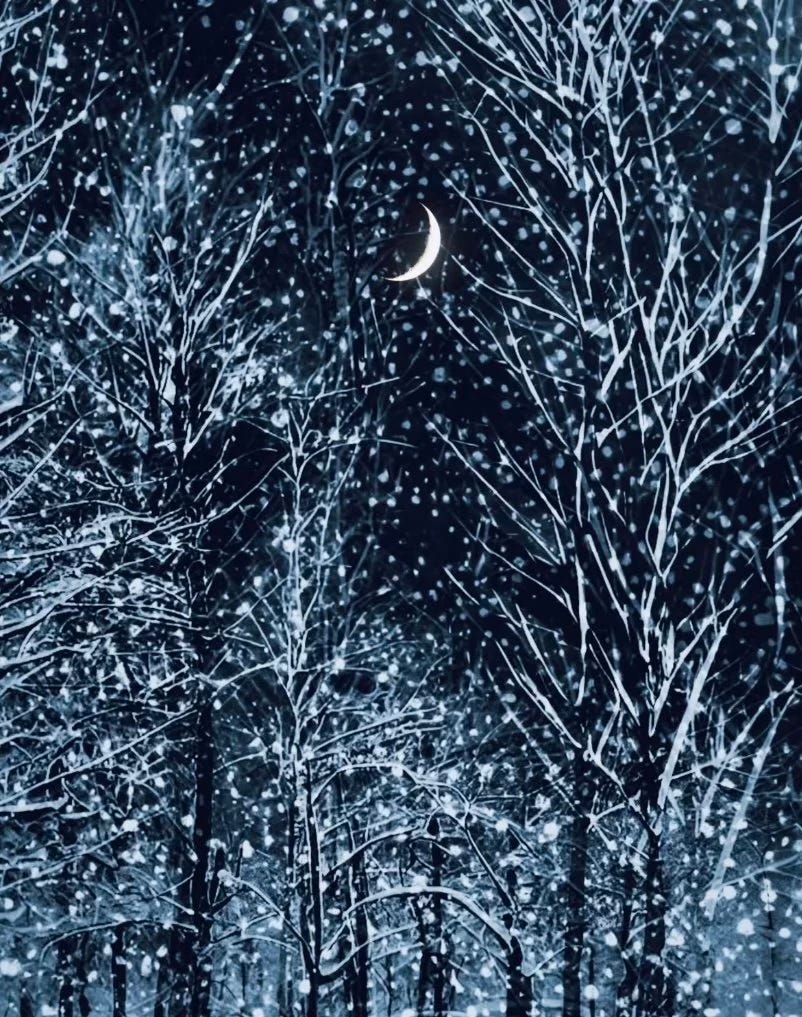
Midnight Moon is a new image that proved to be a favorite among visitors during the Little Italy Art Walk. What surprised me most was not just how many people were drawn to it, but how many wanted to stop and talk—about Midnight Moon, about the Cold Supermoon visible during the art walk (it turns out there are many moon worshipers), and especially the way they described how it made them feel.
Midnight Moon began as a simple photograph I took last winter, on a day of heavy snowfall when the air felt electric from the cold. The finished image has traveled far from that original photo. I worked on it off and on during the year, coaxing it into the visual story I wanted to tell, but it wasn’t until I stood there listening to how people responded to it, and others of the same ilk, that I fully understood how much my work has shifted.
I often find myself in conversations about my photography—sometimes about my work specifically, and sometimes about photography in general. Some people want to know about technique and how I “took the picture.” Others comment on what is the atmospheric quality of an image like this one, and want to understand how it was made. Frequently, someone will remark that my work doesn’t look like a “real photo,” but more like a painting.
The more these conversations happen, the more I understand myself as an artist. I’ve identified as a photographer—and my work as photography—for years, because that’s where I started and because my tools haven’t changed. I still use a camera, still bring my files into Lightroom, and still fall into the familiar rhythm of editing. Yet the word photographer carries certain expectations for many non-photographers, and increasingly, that’s not the kind of photography I’m interested in practicing.
Nearly everyone takes pictures now, and many assume that creating an image like the ones in my gallery (or the work they see online) is simply a matter of pressing the shutter and taking a picture. I’ve encountered thinly veiled hostility when I explain that yes, the image is a photograph—one I took—and then worked with creatively until it reflected the experience or story I wanted to tell. I’ve even had people insist it must be AI-generated. I didn’t anticipate that types of questioning or the accusatory remarks some have made, not many thank goodness, but I no longer engage in those types of conversations.
Not everyone can draw or paint, and people don’t (usually) ask painters to explain how they made something or what materials they used. But because nearly everyone takes photos with their phones, there’s often a failure to understand the difference between casual picture-taking and the work of a photographer or visual artist.
I have a simple way of thinking about that distinction. I cook. I use many of the same ingredients and tools as a chef, but I am not a chef—not even close.
I follow the work of many extraordinary photographers, and I understand that my work is not on the same level as theirs. Still, I don’t assume they’ve “cheated” or fabricated their images with AI. Having the studio has revealed misunderstandings of my own work I was not aware of, and it has been eye-opening to encounter them so directly.
Most people think images begin and end with the camera so they ask what camera was used to take it. I point out some of the images hanging were taken with a camera with fewer megapixels than their iPhone, and most phones have more than adequate cameras to make and print photos.
While the camera provides the raw material (and many creative techniques are done in camera), of the substance of a moment or place—the finished piece comes from somewhere else entirely. Editing has become less about correction and more about shaping, refining, and interpreting. The image becomes a place where memory, intuition, and feeling carry more weight than the technical aspects of photography.
Visitors aren’t asking whether a scene is “real”, they are actually responding to something broader—like the pull of the moon, the stillness, longing, or solitude of Midnight Moon for example. I’ve come to realize that this is exactly what I’ve been leaning into—conveying the essence or experience of a scene or place—even before I fully recognized that’s where my photography was taking me.
The more in-depth these conversations become, the more limiting the single word photographer feels. While it’s accurate to a degree, it doesn’t fully describe the arc of the work or what drives my process. Photography is my language, but it isn’t the whole story. What I’m doing fits more comfortably within the wider space of visual art, where an image is allowed to evolve beyond the initial frame, where interpretation is integral, and where the final work is shaped by something other than documentation alone.
By the end of the art walk—after hearing people describe what Midnight Moon and other similar photos stirred in them and how it held their attention—I realized I had already crossed that line without noticing. My work has been changing for some time, quietly and organically, and those conversations simply brought it into sharper focus.
I haven’t left photography behind at all. I’ve only expanded beyond the narrow idea of what a photograph “should” be. I’m a visual artist who happens to use a camera, and Midnight Moon feels like a clear expression of that—a marker of where my work has been heading all along, and where it continues to go.